What is dispute resolution?
Dispute resolution refers to all processes that are used to address disputes. It includes all dispute resolution methods and approaches from early resolution through to formal tribunal or court processes. Disputes can involve:
- Individuals (eg, neighbours in a dispute over a shared driveway)
- Companies (eg, an employee in dispute with an employer)
- Sometimes the government itself (eg, a company challenging a decision by a government agency).
In all these situations, the parties involved generally have a range of options for managing or resolving the dispute. They may try to:
- Resolve it themselves
- Agree to use the third party to help them (eg, privately contract with a mediator)
- Use a process provided by the government (eg, a government mediation service, tribunal or ombudsman)
- Use a process provided by the private sector (eg, an industry body).
In some circumstances, the formal court system may be an appropriate channel or the last recourse when other approaches have been unsuccessful.
Why dispute resolution is important
Disputes are damaging, expensive, and time-consuming. They affect individuals, communities, organisations, government, and the economy. Preventing disputes, and resolving disputes earlier and more effectively, benefits New Zealand and the economy.
The cost of disputes
Unresolved conflict and substandard dispute resolution are socially and financially costly. The full costs of all types of disputes to government, parties and society are considerable and are a significant impediment to economic prosperity.
The way in which disputes are resolved and the nature of the outcomes can also affect public confidence in government services and perceptions of their quality and fairness.
The functions of government
Government performs a number of functions in the resolution of disputes. It:
- Provides ways for people to raise their issues
- Sets the rules
- Collects information about dispute resolution approaches and outcomes
- Provides complaints and dispute resolution services. Many of these services are delivered privately within industries, sectors, and communities.
Dispute resolution processes
Our ways of dealing with disputes in New Zealand have changed in recent decades in response to a range of social and other changes. There has been a search for more cost-effective and quicker alternatives to traditional court-based resolution, particularly for civil disputes.These alternative approaches have responded to the need for:- More flexibility and less formality
- Privacy and confidentiality
- More specialised and innovative solutions
- Greater participant involvement and empowerment
- Early resolution.
They can often achieve faster outcomes at a lower cost. Parties are also more likely to be satisfied with the result and compliance rates are likely to be higher, so less enforcement should be required.
The role of a neutral third party
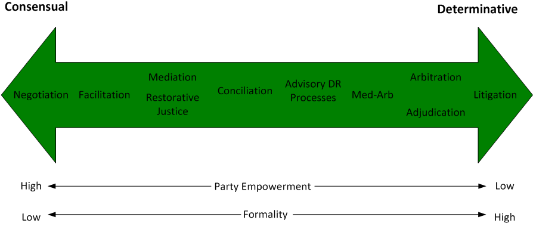
The different types of dispute resolution sit along a spectrum of formality and empowerment, as shown in the image below. A major distinction between these processes is the role played by a neutral third party. An outcome may be agreed between the parties (a ‘consensual’ process), with a neutral third party either facilitating the process or providing expert advice or recommendations in an evaluative way.
Alternatively, parties may require a decision to be made by the third party that is legally enforceable (a ‘determinative’ process).
Dispute Resolution Workshop
85% of companies around the world experience conflict in the workplace to some degree. A dispute in the workplace can be incredibly destructive to good teamwork. Managed in the wrong way, real and legitimate differences between people can quickly spiral out of control, resulting in situations where co-operation breaks down and the team's mission is threatened.
This Dispute Resolution Course provides the knowledge and skills to understand and manage conflict situations, either at work or in group situations.
Source: Mbie